
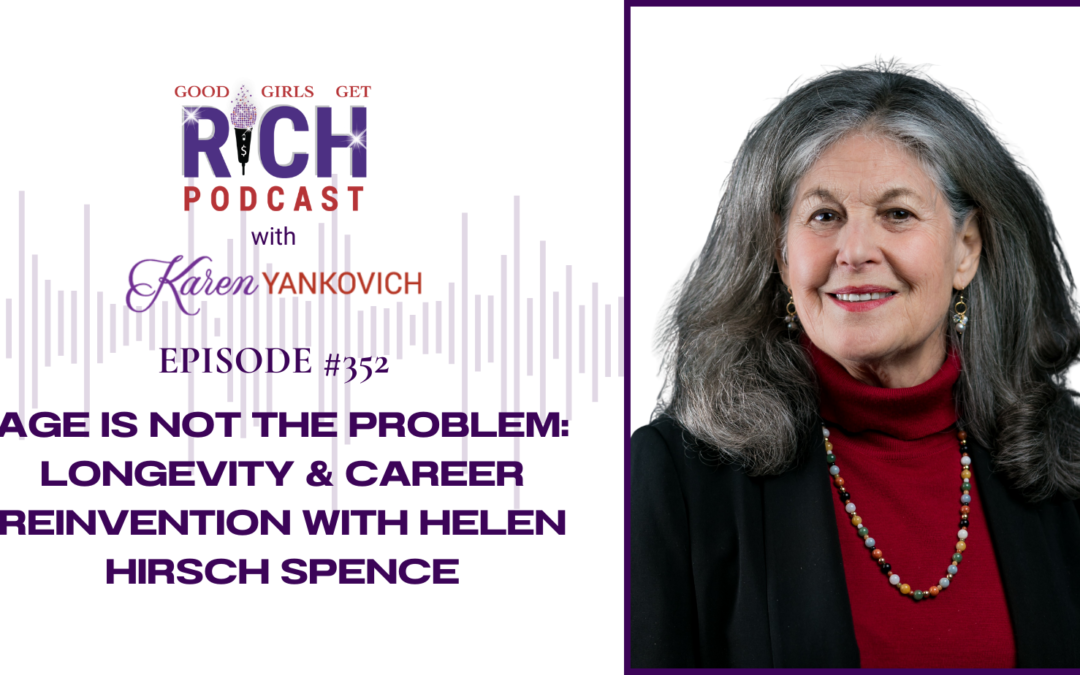
What if the problem isn’t your age — but the outdated rules you were taught to follow?
In this episode of Good Girls Get Rich, I’m joined by Helen Hirsch Spence, and this conversation felt important from the very first few minutes.
Helen is the founder of Top 60 Over 60 and a powerful voice in the age inclusion and longevity movement. She brings language to something so many women feel but rarely name: that quiet sense of invisibility that can show up right when you’re more experienced, capable, and clear than ever.
If you’ve ever wondered whether it’s “too late” to reinvent your career or want more from this next chapter, this episode is for you.
#GoodGirlsGetRich
We want to hear your thoughts on this episode! Leave us a message on Speakpipe or email us at info@karenyankovich.com.
About This Episode & Highlights:
What a Longevity Mindset Really Means
Helen talks about what she calls a longevity mindset — the idea that life doesn’t shrink as we age, it expands.
We explore:
Why the old “learn → earn → retire” model no longer fits the world we live in
How longevity is changing the future of work
Why women experience aging differently than men
What happens when experience is undervalued instead of leveraged
This isn’t about pushing harder or working longer.
It’s about having more choice.
Gendered Ageism and Feeling Invisible
One of the most powerful parts of this conversation is when Helen names gendered ageism — and once you hear it, you can’t unhear it.
We talk about:
Why older men are often seen as “distinguished” while women are dismissed
How bias shows up quietly in hiring and leadership decisions
Why so many women feel overlooked right when they’re at the top of their game
Naming the problem changes everything.
Career Reinvention After 50
Women over 50 are one of the fastest-growing groups of entrepreneurs — and that’s not an accident.
Helen and I talk about:
Why experience becomes an advantage later in life
What it means to build a career portfolio instead of chasing one role
How judgment, perspective, and emotional intelligence become authority
Why reinvention doesn’t mean starting over
This is about building work that actually fits the season you’re in.
Why This Conversation Matters Now
We’re living longer lives, but most systems haven’t caught up.
Helen explains why longevity isn’t just personal — it’s economic. With multiple generations working side by side, organizations need women with lived experience, clarity, and leadership more than ever.
Your relevance does not expire.
It evolves.
About Helen Hirsch Spence
Helen Hirsch Spence is an age inclusion advocate, speaker, and founder of Top 60 Over 60. She publishes the Age Sense newsletter on LinkedIn and works with organizations preparing for a multi-generational workforce.
Her upcoming book, Reset: Make the Most of the Rest of Your Life, launches in Spring 2026.
Final Thought
This episode is a reminder.
Your next chapter isn’t smaller.
It’s more intentional.
And it gets to be designed on your terms.
Join us at the Visibilty Salon
If you’re drawn to conversations like this—about leadership, visibility, reinvention, and navigating real-life transitions—you’d love the Visibility Salon. The Visibility Salon is a space for smart women to have meaningful conversations about who they’re becoming, how they want to show up, and what it really takes to build influence and income in this season of life.
Help Us Spread the Word!
It would be awesome if you shared the Good Girls Get Rich Podcast with your fellow entrepreneurs on twitter. Click here to tweet some love!
If this episode has taught you just one thing, I would love if you could head on over to Apple Podcasts and SUBSCRIBE TO THE SHOW! And if you’re moved to, kindly leave us a rating and review. Maybe you’ll get a shout out on the show!
Ways to Subscribe to Good Girls Get Rich:
- Click here to subscribe via Apple Podcasts
- Click here to subscribe via PlayerFM
- Good Girls Get Rich is also on Spotify
- Take a listen on Podcast Addict
Read the Transcript
GGGR Episode 352
00:00
Karen,
00:09
hello, hello, and welcome to another episode of The Good girls get rich podcast. I’m your host,
Karen Yankovich, and I have Helen Hirsch Spencer with me today. I’m so excited for you to
meet Helen. We had like, a five minute conversation. I was like, oh, no, I need we need to talk
about this on my show. So I’m excited to have her here with me today. She’s a dynamic
speaker and age inclusion advocate who’s transforming the way we think about growing older.
With over 35 years in leadership across education and now the founder of top 60 over 60, she
brings deep insight and bold ideas to conversations about aging, equity and the future of work,
her engaging nonsense approach has made her a sought after voice for media outlets,
conferences and organizations looking to better understand the opportunities of an age diverse
world. Helen is available for commentary, interviews and features on topics ranging from
longevity and leadership to social innovation and the economic impact of demographic change.
Her book reset, make the most of the rest of your life will be launched in the spring of 2026 I’m
going to bring Helen up here with me. And Helen, I’m so excited to have this conversation
today.
01:18
Yeah. So Helen and I met like through some it was sort of LinkedIn connection. Actually, I saw a
post that an interview she had done with somebody that I knew. This is how it works, you guys.
01:29
I saw an interview that she had done with somebody. I was intrigued by the interview and
reached out to her, and we had a quick conversation. I actually wasn’t quick. I was sitting in a
parking lot, and I think we talked for way longer than I thought, but we would, yeah, the shore
almost closed on you.01:44
But I was so intrigued by her perspective on how she talks about like in her bio and age diverse
world, that I wanted to have that conversation here. So Helen, why don’t you tell us a little bit
like behind the bio, tell us a little bit about you and what kind of brought you to this world of
talking about top 60, over 60, or making the most of the rest of your life
02:04
easy answer, the reality is that in my mid 60s, I was losing my self confidence. I felt like I was
irrelevant, invisible. You know, the typical kinds of feelings that I now recognize as having been
02:21
beliefs, myths about aging, and it’s called self directed or internalized ageism. But I didn’t know
that. That’s what it was at that point. And so it was when I realized it. I thought, Oh, my God, if I
feel this way, having had an outstanding career in leadership and in many different areas, not
just in one what what is the average middle to older aged woman feel like when she hits this
stage? And so I delved into that. I took courses on social entrepreneurship. I mean, having been
in schools my entire life, I’m passionate about learning and growth, and always am very curious
so and I asked too many questions, and people get annoyed at me, but I really don’t care,
especially not at my age. And so much fun, right? It’s so much more not care what people think
about you well, you know. But that’s one of the gifts of growing older, and that’s one of the
biggest gifts of growing older, is caring less about what other people think about you, you
know? So I investigated, and then I realized, you know, the problem is we don’t have any really
good role models as older adults. And we need to recognize the contributions, the value and
the respect and dignity that older adults actually deserve but are not getting. And that’s why I
came up with the idea of top 60, over 60, which has expanded and gone different places, but
which I still will do and hopefully in the near future. And you know, I just have been working
constantly, and it’s become like a passion project to help people like yourself and others
recognize that that old narrative of learn, earn, retire, is dead. It was dead in the 20th century,
and that we have 20 to 30 years longer to live, which is referred to as a longevity dividend, and
we’re not taking advantage of it. And as a society, we are penalizing older people because we
still believe in the old, outdated notions that life ends at 65 essentially. So, right? I’m here to
broadcast that that’s not the my 65th birthday is next week, so I hope it doesn’t end at 65 it
doesn’t end.04:33
The reality is, it begins at 60 Yeah. Well, you know, here’s the thing, I agree with you, and I, you
know, it shifts, it changes. I was just saying. I was just saying, so I don’t normally talk about
time of year or whatever, but it happens to be that we’re doing this interview with Thanksgiving
week, and I’m hosting Thanksgiving at my house, and a ton of people, like 17 adults and seven
kids or something like that. And I was saying to my partner the other day, like, I got I really
want to.
05:00
Like, make some more cookies and bake a cheesecake, but, like, I can’t do what I was able to
do for Thanksgiving 20 years ago. So there is a reality to there being a shift in but I will say it’s
a conscious shift, right? Like, I could have done it right, but I didn’t want to kill myself to do it
like I wanted to enjoy. I want to enjoy the lead up. I want to enjoy hosting and having
everybody at my house and not be exhausted, right? So maybe 2030, years ago, I could have
done that and not been exhausted, and now I don’t feel like I can do that, so, but, but I’m
making these conscious choices as I’m stepping into each new year and each new chapter of
my life, right? On how I want to spend my time and how, you know, and how I want to create
my my career, right? How I want to create my career? I, for sure, I loved that you I loved one of
the things that you said and I wanted, that’s really what I wanted to dive into, is we don’t
remember, or we don’t realize, or we don’t think about the fact that, because we live longer
lives, we have longer productivity opportunities, right? And at the same time, you know, I don’t
think you’re saying, work yourself to death, right? Work till you die. So tell us a little bit about
that, right? Tell us a little bit about that. What does that look like? Okay, so for you, there’s 60s
and 70s and 80s. So I’m 76 at the moment. And06:19
you know, if I think back at younger years, 76 would have been absolutely ancient. But the
truth of the matter is, one, I don’t feel it. I don’t behave as if my life is ending. What we have to
recognize today is that we’ve got a multi stage life, and this is what I would encourage a lot of
younger people, or people who are hitting their 40s and 50s, in particular. For women, there’s
so much gendered ageism out there, which really refers to the intersection of sexism and
ageism. So it’s a double whammy for we women, you know, we only are getting into our stride
and into our 50s or early 60s when our families are more or less off and launched, so to speak,
and we can really devote the attention to ourselves or to whatever it is we choose, and that’s
when we can really reinvent ourselves, if that’s what we want, or we can do it later. But there’s
no real reason why we have to stay in the same paradigm as our parents were in. In other
words, if you’re 45 and you’re not happy with what you’re doing, my recommendation to you is
take some time off, a gap year, a sabbatical, whatever the hell you want to call it, it doesn’t
matter. The point is, you can get back into the workforce, although it’s much more difficult as
an older woman than it is when you were in your 30s, but you can if that’s what you want, but
you can also maybe start something new. You can get a new career. You can go back to school.
Universities are going to have to shift to accommodate older populations, because we’ve hit an
age cliff, especially in the United States. I live in Canada, at age 18, there are no more 18 year
olds coming up in the numbers that there were before. In Canada, we have more people over
the age of 65 than we do under the age of 14, and that’s been the case for over 10 years. In
the United States, it’s true as well. They’re something like last time I looked over 12,000
Americans turning 65 every day. You have far more older people by 2030 than you do have
young children. So that requires an adaptation, a readiness that neither businesses nor
individuals are ready for. But we’ve already seen we’re a little bit ahead of you in that case,
that there’s a talent shortage with all the politics going on, which I won’t get into, but with less
immigration and so on, we need to take advantage of the experience and expertise that you
Karen and I could bring to businesses or to entrepreneurship or to any institution or anything
that we want, but we’ve been cut off traditionally because of our gray hair, and when I talk
about gendered ageism, I want you to recognize that I could be a bald, beer bellied older
gentleman, and I would be considered distinguished, but with my gray hair, I’m over the hill,
you know. And that’s the that’s the transformation. It’s that narrative that we really have to
shift well. And I think it is shifting. I mean, one of the things, one of the things you said was, you
know, take a gap year. And I heard collectively, the universe, women in the universe, going,
how do I describe that on my LinkedIn profile? How do I describe that? That like, you know,
when you, when you maybe take a few years off, if you’re having children, and you decide you
want to take a few years off, yeah, we’ve been taught to worry about that gap. That’s right,
instead of embracing that gap exactly and owning what we’ve done in those years and then
just moving forward from that space, but you could not have done it if you didn’t have people
my generation who was a feminist in the 60s and 70s, and who fought for for
09:57
maternity leave and so on and parental leave.10:00
For men as well, but you can do that today much more easily, at least. You can hear, I know it’s
bit more difficult in the States. However, it still exists. Those possibilities do exist, and we need
to recognize them, and we need to really fight for them. And those of us who are a little bit
older, who’ve done that, we can support you, and we need to support you. You need to
understand that your your belief in aging is misguided. The brain continues to grow. There are
lots of advantages and benefits to growing older. For instance, we actually have more
connections, neural connections, than before. We have crystallized intelligence, we have better
emotional regulation, we have better judgment and perspective. And this is all because of lived
experience. It’s not because of intelligence necessarily that helps, but it’s not the, you know,
the only thing so. So if you listen to my TEDx talk later, which, I think,
11:03
which is amazing. It’s all about embracing age with a longevity mindset. And a longevity
mindset just means a growth mindset focused on the positives of aging. And there’s enough
psychology out there to, you know, to understand that if you think positively about growing
older. This is a study done by Becca Becca Levy, she has a great book out. I think it’s called
breaking the age code. But I may be mistaken, and I’ve gotten somebody else’s name mixed up
with it, you will live 7.5 years longer with a positive mindset about aging, and you will heal
faster. You’ll have less cognitive decline. That is how absolutely important our mindset is,
especially as we grow older. So important. Well, let’s, let’s talk about entrepreneurism in this
whole in this whole conversation, because I, I’ve been seeing a lot of studies lately, and I don’t
have any in front of me, but I can find them. If anybody wants them, you can message me on
LinkedIn about how women over 50 are the fastest growing demographic of entrepreneurs. And
I love hearing that, because I feel like,12:10
you know, I’m on the, I’m on the other side of that, right? But, but my generation, we were
taught you, you know, you get married, you have kids, you have a job, and you stay there till
you retire, right? So it’s just, it’s just the women now that are over 40 and over 50 and over 60
that are realizing, Wait, what if I don’t go back to work after the pandemic, or what if I don’t
want to do this anymore? Or, in my case, I really wanted, you know, I’ve had entrepreneurial
endeavors my whole life, but I had a paycheck job up until, like, 10 years ago, but I decided I
wanted to be able to have more freedom in my life, to be able to spend time with my kids and
their kids as they started getting married and having kids. And that’s why I chose to do what I
do. If it had been 10 or 20 years earlier, like, I don’t know that the world would have been ready
for that, right? But the world is starting to shift and being more ready for women entrepreneurs.
And I think that’s what that, to me, is one of the reasons why we’re seeing statistics like that,
because women are starting to realize, Wait, what if I do do something different? That’s right.
And entrepreneurship, I mean, so there are, there’s lots of studies that actually prove that
those of us who are over 50 or in particular, it’s like, I think it’s a Kauffman study that older
entrepreneurs are more successful. It makes sense, because we have networks that are
established, we may have finances that are established, we have the experience that gives us
a performance edge. So it’s not surprising that older entrepreneurs may be more successful at
their endeavors that so I don’t know the statistics about women, but I know there are more
women who are getting into entrepreneurship over the age of 50 for the simple reason that
they cannot be they are left out of the hiring of Typical jobs no matter what, and that the
average woman who’s over 50, who tries to be become an employee again, often takes up to
two years to find a job that is way below her pay level and her skill level. So they give up, and
they become entrepreneurs. And I mean you, you have to think about what you really value in
life. You know, if you value family connection and interpersonal relationships and you don’t
have time for it because you’re killing yourself, you know, from nine till seven every night,
yeah, you know that’s no life. And you know young people today get it a lot better. They’ve
seen our generation, or at least my children have their their Gen X, and millennials, they know
that. You know that it’s a short time that they have to spend with their children, and that’s
when they wanted to, that’s one of the things they want to do. And they want to be respected
for having those beliefs. And they’re looking for jobs where they’ve got the kind of.15:00
Benefits that will give them the flexibility that they or need. Yeah, you mentioned, you
mentioned women that are kind of just not able to get where they want to get in the workforce.
I talked about, I’ve been talking about that for years. To me, when you take control of your own
destiny, like with an entrepreneurial endeavor, or at least your own brand, right? Really into the
skills you have, the experience that you have, and the expertise that you have. I think we can
kind of just, like, say, you know, screw the glass ceiling with the glass ceiling, like it’s there, you
know, just go around it, right, or ignore it. Or do, like, when you hit the glass ceiling doesn’t
stop. It doesn’t mean you have to stop. You can just move on and move somewhere else where
there is no and I, I firmly believe it comes down to having, I think, a community of people that
support you with this, because we’re having this conversation. But not everybody has people in
their lives that can have these kinds of conversations with them, but also having to be brave
and confident in your skills to really say, What can I do if I if I hit my top here, what can I do
that’s different than this? And it takes guts, because we were not brought up to to know that,
that there was something else that we could do. And I’ve been giving courses on transitioning,
finding purpose, you know, all of this sort of transition territory that can happen as a result of
divorce or a new job, or being nudged out or totally eliminated from the workforce. You know, it
really is probably one of the the most
16:31
challenging parts of life. It because you’re also, as I say, aging, and with aging, and because of
our society has spent so much time, perhaps,
16:42
obsessed with youth. And,16:45
you know, we’ve been a youth centric society. I mean, look at television, look at media, look at
magazines, podcasts. I mean, how often do you see well, now we’re beginning to see Isabella
Rossellini and other people with L’Oreal because they’re ahead of the curve, they’re smart.
They’re getting the women who the generation of women who have the most wealth on their
covers and so on and more. It’s called the longevity economy, and we need to develop that
better. And we met. We need to make people help people understand that this is here for the
long haul. We are not replacing ourselves. Birth rate wise in any country at this point, only
underdeveloped countries, a few of them, still have more young people than older people.
Wow, yeah, no, we are interesting concept to think about. I had not really thought about that.
Well, you need to think about it, because that’s the future when we talk about the future of
work, we have to reincorporate all sorts of people into the workforce that are now, typically
older. That means we have to reskill, upskill, you know, get them credentialed, which is an
opportunity for colleges and universities that no longer have young people attending. They
need to, you know, rethink how they are going to offer to be able to stay sustainable, you
know, financially. So there are tons of implications. That’s what I’ve been working on here in
Ottawa, is looking at longevity and helping others understand this isn’t this is a mega trend
equal to climate change and and technology, and yet we are not thinking about it in those
terms. And we need to for survival, you know, for survival of the economy, and also to keep
older adults out of the healthcare system. If they’re engaged and they’re working, they stay
cognitively, socially engaged. You know they have, they have benefits, they have all sorts of
things that that may enable them to stay healthier for longer, because living longer is totally
irrelevant, if it’s not a better life or a good life, right? Yeah, yeah, I agree. So let me ask you
this, you you have a lot more background in education that I have? Do you I feel like I’m seeing
changes in education, in that. I definitely think, you know, education is, I think education has
saved us in so many waves, right? Like, you can, you know, I
19:15
at the same time I think we’re also recognizing experience, right, as we’re recognizing
education, right? And I was, I was actually having a conversation with my son. So this doesn’t
really fall into the ageism category, but I was having a conversation with my son. Ageism goes
both ways, yeah? So he, so he works for a company that’s having, it’s a big company. They’re
having massive layoffs, and he has not been laid off, but everybody on his team has been laid
off, so demoralizing in many ways for him, yeah? So he was looking at other opportunities, and
he was like, Well, I don’t have this particular degree. I don’t have that particular degree. And I
said to him, you know, here’s the thing, somebody up higher in HR is saying, and we need this
particular degree for this particular position, but the person that’s hiring you, they want your
experience. They want to know you can do the job. You know how to do the job, you’ve done
the job before, and you can do the job.20:00
Up for them. They don’t really care as much about that. So I to me that almost comes down to
the specialty certifications and things like that. Like, I do think a degree is still value,
immensely valuable. But at the same time, I think we need to recognize that these specialty
certifications are something that is really it helps with you, with your personal brand, right? Like
everybody has, not everybody. But, you know, many people have a college degree, but not
everybody has the specific certification, the specific skill. How do you what are your What are
your thoughts on that? Well, I do think that we there’s such a great need now for technical skills
and other skills because of AI, for instance, knowledge workers are the ones who are going to
be knocked out of the employment cycle, probably first. Because the reason for these layoffs in
the company that So, which is totally unreasonable too, because we need them in order to
manage the systems and whatnot. I mean hiring, or HR is a great example. I mean, a lot of the
AI hiring is so biased, one against women, against older people, against all sorts of other, you
know, classifications of, you know,
21:08
race and so on. It’s a real problem. But it it, it’s a model that has been developed by men talk,
you know, teaching AI what it is that they need. And so there isn’t the diversities. So we need
that diversity in the workforce to continue to work with with AI, I don’t know if I hope I’m
making some sense. No, you are, you are. It makes sense. It does make sense. And you know, I
also, you know, told him, and would tell anybody else listening, pull on all that expertise when
you’re stepping into whatever your next chapter looks like, right? Because it’s that expertise
that we21:43
we think is because it comes easy to us. Is it as valuable as the the other things that we think
people are looking for, but it’s really the expertise. Sorry, I think however, we have to be
creative about that and not stick in that box of the expertise we have. Think outside the box.
Think where else can my training or my expertise be used? So I was trained as an educator.
However, I can assure you that most of the skills I’ve learned are extremely valuable in every
other realm, because I can listen, I can interact with people. You know, I have the interpersonal
skills, the soft skills, and that is what is emphasized today in the in in the working world, are
those soft skills that many people have lost along the way because they’re interacting with
machines rather than with people. So I would always say, for somebody, don’t downplay any
credentials you have play up whatever you have and think how you can explain how valuable
your your expertise is in wherever it is that you are applying for a job. You know, I also think
that in many cases, entrepreneurism is is going to help them get to their financial goals faster
than getting a job. I mean, there are certainly jobs that pay well, but there’s also a lot of people
that get kind of stuck in this place where, first of all, they don’t know if they’re gonna be able to
keep their job right, so you don’t have as much control over usually when you were employed.
That was the security. Now it’s the opposite. Now, if you are leaning into your personal skills
and entrepreneurism, that’s more security than a paycheck. I wouldn’t agree. I wouldn’t
necessarily say that that’s the case, Karen, but it depends on the individual and what the job is.
What we do know is that in the olden days, we had companies that were very solicitous
towards their employees. You know, they got gold watches at the end of the time they
respected them. Retention was everything they were loyal to them, and their employees were
loyal to them because they got benefits and everything that no longer is the case. And
therefore these young people who are looking for jobs are switching, very often, more readily
and more easily because they’re not finding what they want, but it’s also because the
companies are not committed in the same way as they were to their employees in times past.
Now I understand that. I mean, that’s the evolution of work and what’s changing. So, you know,
there’s a lot of literature out there on leadership and what leaders need to do in order to retain
employees, and one of them is to give them lots of opportunities to change roles within the
organization, so these people don’t get bored or soured or unengaged in their jobs. So there’s
lots that can be done. There’s a lot to be learned, and it’s a shift right now. We’re going through
a huge, huge shift. Yeah, yeah. So what do you see ahead? What do you see ahead as you’re as
you’re moving into your next chapters and you know, and what you’re doing with the 60 over
60 and and the book and other things that you’ve got going on, where are you leaning into
Yeah, well, I’m leaning into this in a big way, because I think there’s more and more need for
young people in particular.
25:00
To understand that they have a multi stage life. They can have like what’s called a career
portfolio, career in which they change careers, because they are going to be working into their
80s and 90s as the norm. Their life expectancy is, on average, 100 years, and that means they
could be 12025:19
or they could be 80. But the reality is they’re going to be working a lot longer, and so there’s
going to be a need for them to be more flexible, more understanding of the changes that are
going to take place, and everything is going to shift. And it is a it’s starting, but it’s extremely
slow in North America. We are not age ready at all. So that’s what I’m working on. I’m working
on organ is working with organizations and businesses to help them prepare for this future of
multi generational workforce. And that’s really important. People don’t understand that we now
have up to five generations working at the same time, and their values are very similar. Their
styles of communication may be very different, and therefore there’s sometimes some conflict,
but the conflict can be easily resolved if you start talking to people about it. So I really am a
firm believer also in what I refer to as reciprocal mentorship, so we can no longer think that we
as elders have something to offer wisdom wise to young people. It’s not a one way street. I
have as much to learn from the young person as they have to learn from me, and that’s always
been why I’ve been passionate about being in schools as I was in education, in public schools
and in private, independent schools, because I’ve learned and probably the best experiences of
my life are a result of the encouragement of students I’ve had who said, you know, you could
do this. Mrs. Spence, go give it a try. And they were right, and they encouraged me. So it goes
both ways. We have to be open minded, obviously, too. Yeah, yeah, you know. So, yeah, yeah.
Interesting. So interesting. It’s so interesting. Well, listen, I love the idea. I love the mindset
shift, or the just the identity shift, stepping into your next decade, whatever your next decade
is, knowing that there’s more decades ahead then you do whatever you want. You could work if
you want, you could sit on the beach if you want, you could play golf if you want, or you can do
all of those things if you want, right? And and that we’re not locked into, you know, a
27:23
modular thought they were going to be locked into. The point is, you can do things differently
now than you could have before. Without being a privileged white person. You can step out of
that paradigm and move yourself forward in different ways. And you know, money isn’t
everything. I know capitalism is is God at the moment, but it doesn’t mean that there’s only one
type of system in which you have to operate. You can operate with kindness and you know
honesty and trustworthiness, and sometimes you know just being being a good person means a
hell of a lot more than you know what you bring in, or you know in terms of what you do. But
now is the time to start thinking differently, because, especially if you are young, because it’s
not the way it was. And I mean, we see it already. We have children who are going back living
with their parents because they cannot afford it. And that’s the other thing I wanted to mention,
is that if we live longer, we need to be financially secure for a longer period of time, which
necessitates us working longer. Yeah, well, it’s not going to just be28:32
frivolous. It’s going to be by design, if you’re lucky, by default, if you just lose track, you know
you need to be conscious of what lies ahead and and be optimistic. That’s all I can say. That
makes a huge difference. Yeah, well, I’m looking forward to it. I’m looking forward to spreading
this message and talking more to more audiences to help them understand and I guess, and I
believe in role models, and I believe that when I get going with the top 60 over 60, there will be
that that’ll move some people forward, because they’ll see it. But I feel like I’m a living role
model, having started something new at age 67 I love that. I love that well. So you have a
newsletter that comes out regularly called age sense. It’s a LinkedIn newsletter. So we’ll put the
link to your LinkedIn in the show notes and the link to your newsletter. You know, I’m assuming
that if we’re subscribed to the newsletter, we’ll get some information on when your book is
coming out, right? Because I know the book is is almost ready for pre sale, so that would be
great. And then,
29:38
yeah, and then, and, you know, Helen and I met and having conversations around speaking
engagements, right? So
29:46
I will say to you, and I will say to anybody listening, if you have an audience of people that need
to hear this message, reach out to Helen, because she you know, I think you’re a leader in this.
I talked to a lot of people about this topic, and this is a perspective that I had in.30:00
Heard yet the way, the way that you described it, so I appreciate you bringing this down to a
level that we can all understand and that we can all relate to. And that’s exciting, right? It’s
exciting to think about stepping into a next chapter with with with excitement and hope and
and and positivity around what it could be, and watching it unfold in a fun, positive way, as
opposed to thinking, okay, every day another bone is gonna hurt, you know, like, you know it
will hurt, but get over it. Get over into it anyway, right? Make, let buy the cookies. Buy the
cookies and make something else, right? Yeah, look at it as an adventure to explore, you know.
Yeah, it is. It really is, and you’ll eat. There’s a book out there called the U curve of happiness
that shows that when you’re a child, young child, and an older adult, those are the best times in
your life. That’s really hard to convey to somebody in their 30s and 40s who think they’re living
their best life, right? It gets better. Yeah. How fun is that? I know. Helen, thank you so much for
this conversation. This has been great. I am very much looking to forward to your book and to
keep keeping in touch with you on an ongoing basis. And I think that this is a conversation we
all need to be having more of. So thanks for starting the conversation. Well, well, I welcome it,
and I thank you very much, Karen, for for having me on your show, because I’m delighted to
talk about it. Well, I appreciate it. I appreciate it. And for you listening, make sure that you’re
connected to Helen. Make sure that you’re connected to me on LinkedIn. We’ve both got a lot
of things coming up in the next year that you might want to be interested in checking out so
and then come back on. Come on back here next week for another episode. We’ll see you then.