
It’s a career conversation.
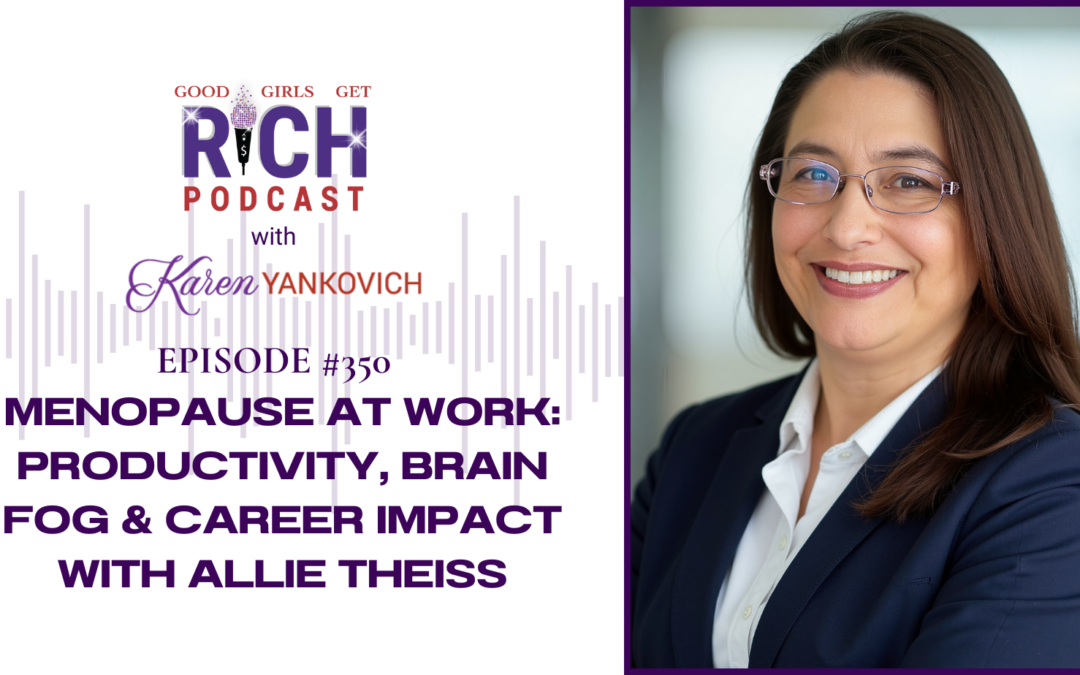
In this episode, I sit down with my friend and colleague Allie Theiss for an honest, grounded conversation about how menopause actually shows up in our work and businesses—and why pretending it doesn’t exist is costing women far more than we realize.
If you’ve ever wondered why work suddenly feels harder, why brain fog derails your focus, or why your energy no longer follows the rules it used to… you are not alone.
#GoodGirlsGetRich
We want to hear your thoughts on this episode! Leave us a message on Speakpipe or email us at info@karenyankovich.com.
About This Episode & Highlights:
Menopause, Productivity, and Work Performance
Menopause can impact everything from memory and concentration to sleep, mood, and stamina. And when you’re leading teams, building a business, or navigating a demanding career, those changes don’t stay contained.
In this conversation, we talk about:
- How menopause affects productivity and performance at work
- What “menopause brain fog” really feels like (and why it’s so frustrating)
- Why women often blame themselves instead of their biology
The difference between working harder and working smarter during this season - Why menopause impacts entrepreneurs and corporate leaders in different—but equally challenging—ways
This episode isn’t about fixing women.
It’s about understanding what’s happening so we can lead, work, and live with more compassion and strategy.
Workplace Accommodations That Actually Help
One of the most important parts of this conversation is naming what support can look like—without making it complicated or expensive.
We talk about simple, realistic workplace accommodations, including:
- Flexible schedules that align with energy and focus
- Cooling strategies for hot flashes (yes, even during meetings)
- Creating space for rest, regulation, and stress management
- Why awareness alone can dramatically improve outcomes
Whether you work for a company or your company is you, these ideas matter.
Mind-Body Support, Brain Fog, and Daily Life
We also explore the mind-body side of menopause—because hormones don’t operate in isolation.
You’ll hear us discuss:
- Hormones, brain fog, and cognitive load
- Nutrition, sleep, and movement as foundational support
- Supplements, hormone replacement therapy, and why there’s no one-size-fits-all solution
- Small daily shifts that can make work feel more manageable again
This is about options, not prescriptions—and giving yourself permission to experiment with what actually works for you.
About My Guest: Allie Theiss
Allie Theiss is a board-certified sexologist, menopause care provider, and PhD candidate in mind-body medicine. She’s the founder of Menopause Wellness and The Passion Zone, where she helps women in midlife reclaim clarity, vitality, intimacy, and confidence through science-backed, holistic frameworks.
Allie is also a graduate of my She’s LinkedUp Accelerator, and it’s been such a gift to watch her step into greater visibility and leadership with this important work. This conversation is a beautiful example of what happens when women fully own their expertise and bring essential conversations into the spotlight.
You can learn more about Allie’s work here:
🌿 www.menopausewellness.co
💖 www.thepassionzone.com
Related Episodes You Might Love
If this episode spoke to you, I’d also recommend these Good Girls Get Rich conversations:
From Corporate to Consulting: How to Leverage LinkedIn During a Career Transition
Why LinkedIn Feels So Heavy for Smart Women — and How to Change That in 2026
Join us at the Visibilty Salon
If you’re drawn to conversations like this—about leadership, visibility, reinvention, and navigating real-life transitions—you’d love the Visibility Salon. The Visibility Salon is a space for smart women to have meaningful conversations about who they’re becoming, how they want to show up, and what it really takes to build influence and income in this season of life.
Help Us Spread the Word!
It would be awesome if you shared the Good Girls Get Rich Podcast with your fellow entrepreneurs on twitter. Click here to tweet some love!
If this episode has taught you just one thing, I would love if you could head on over to Apple Podcasts and SUBSCRIBE TO THE SHOW! And if you’re moved to, kindly leave us a rating and review. Maybe you’ll get a shout out on the show!
Ways to Subscribe to Good Girls Get Rich:
- Click here to subscribe via Apple Podcasts
- Click here to subscribe via PlayerFM
- Good Girls Get Rich is also on Spotify
- Take a listen on Podcast Addict
Read the Transcript
GGGR with Allie Theiss – Final
SPEAKERS
Speaker 1, Karen Yankovich
Karen Yankovich 00:00
Karen, Hello everyone, and welcome back to another episode of The Good girls get rich
podcast. I’m your host, Karen Yankovich, and I am so excited to have this conversation today.
I’ve got Allie theis with us today, and Allie. Allie and I have known each other for a lot of years.
She’s been a client we’ve done, we’ve had a lot of amazing conversations. And she posted
something on LinkedIn a couple of weeks ago that I was like, I want to talk about that on my
podcast. And that topic was, how does metaphor menopause affect your work and your
business? And it is a thing. Man, I, you know, personally, can attest to that. So let me tell you a
little bit about ally. Ally is a board certified sexologist, menopause care provider and PhD
candidate in mind body medicine. She’s the founder of menopause wellness and the passion
zone, where she helps women in midlife reclaim vitality, intimacy and confidence through her
signature frameworks, thrive for menopause health and she be me for sexual wellness. Ally
integrates science, holistic practices and sensual mindset work to transform how women
experience their bodies, relationships and desires during menopause and beyond. So let me
bring Allie up here and let’s chat. Ally, I’m so happy to be doing this with you today. You know
how much I
S
Speaker 1 01:19
love the work you do. Hello, hello, Karen. Thank you for having me. It’s great to be here.S
S
Karen Yankovich 01:24
I’m so excited to do this. So before we get into all the good stuff, tell us a little bit about you,
like, tell us a little bit behind the bio. What kind of brought you to doing what you’re doing
today? And that’s a big question to start off with.
Speaker 1 01:40
I’ll try to make it as possible. The bottom line is, I hit perimenopause and my effin medical
professionals dismissed me. That’s, that’s what it came down to, yep. And I’m like, Oh no,
Karen Yankovich 01:59
eat less, move more, you know, here’s
Speaker 1 02:03
my anxiety meds. This is all you need take these meds, not a bunch of BS, right? So that that’s
what got me to start doing the deep dive on menopause, and that’s actually what got me to go
back to school for my PhD in mind body medicine.
Karen Yankovich 02:20
I love that, because, you know, I mean, in every single solitary part of our lives, our minds can
get in the way of our success, you know. So I love, you know, I have such a I mean, I thoroughly
respect Western medicine. I will take the medicine when I think I need the medicine. I also
haven’t taken an antibiotic in like 30 years, not think, but I would, I would if tomorrow I thought
that there was a need for it, right? So I like, you know, I if I can find a way to stay healthy. I
remember having a conversation one time at a family dinner, and everybody’s talking about all
the medication that they’re on and their blood pressure medicine and this and that. And I’m
like, you know, you all make fun of me going for acupuncture, but, um, I don’t have any of that
medication. Like, I take thyroid medication, you know, but, like, I’m not taking any of that stuff.
I you know? It just was so eye opening to me to listen to everybody around me talking about
just the laundry list of medications, and I would take it if I needed it. Like I said, I take my
thyroid medicine, right? But I would rather you say to me, give me a month. Give me two
months. Let me see like let me, let me see if I can work this out somehow. And that’s where I
think the mind body comes into play.S
S
Speaker 1 03:28
It does. It does once, once you start making lifestyle changes, mindful mindset changes, if
supplements, if needed, it can open up a whole new world that isn’t driven by taking the
almighty pill at 4pm
Karen Yankovich 03:49
right, right. So how did when you decided you wanted to do this, how did you start to move this
into your career, as opposed to just something you were doing for yourself?
Speaker 1 03:59
Oh, well, since I’m Gen X, and most of my friends are around my age, I got into plenty of
conversations about menopause, and we were like, We don’t know what the heck this stuff is.
You know, our our moms, if they even spoke about it, it was about, all about hot flashes, right?
Hot flashes, mood swings, that’s, that’s what we heard, but the laundry list of over 60 different
symptoms that women can get drove me into instead of just talking about it with friends, really
setting out to help women with menopause, because there are not enough people out there
who are educated in menopause to lend support,
Karen Yankovich 04:44
yeah, and you know we, we can’t. I don’t think anybody listening, regardless of where you
stand, on whatever the eastern, western mind body medicine spectrum. I think anybody knows,
any woman, especially knows that hormones are a thing. You know, like, I remember back in
the day, you know, when I had regular cycles. I remember, like, having these, like, moments,
and then be like, Oh, wait, wait, what time of the month is it? You know, like, I could recognize,
and there were other times of the month. I’m like, Oh, this is it. This is my productive week.
Let’s get moving, you know, like, so, so, for real, it’s been a it’s been a thing, and then all of a
sudden, it’s like this cyclone or roller coaster of hormones, and then, and then, you know, and
we’re supposed to just continue with our life, like, you know, like, you know, it’s Tuesday, right?
So, so, you know, I know we can talk, there’s so many angles on this, but what I really love, and
what I really wanted to talk about today is the angle and how, it affects your, your ability to
have a career, whether you’re an entrepreneur or you, or you or you work for you give a
paycheck. You know, it’s, it’s so not talked about, right? It’s so not talked about. So let’s talk
about it from that perspective, right? Like, what kind of impact does menopause have on our
productivity.S
Speaker 1 06:01
Let’s just start with that. Oh my gosh. It seeps its way into every facet of our life, including the
workplace, whether you work for somebody else or you work for yourself as a self, self
employed. So I work for myself, and there are days because of menopause, not as frequently
now as when I started with perimenopause, I didn’t want to get out of bed. It was difficult to get
out of bed and actually put a cohesive sentence together because of being tired, because I’m
not sleeping well, body aches, hot flashes and brain fog. You add those things up for being self
employed, and it takes some some juggling in order to get stuff out that you need to get out for
the day, right? And talk to the people you need to get out to when you work for somebody,
most workplaces don’t even recognize that women go through menopause. It’s not even a blip
on their map anywhere. So it’s like she forgot about a meeting. There wasn’t, there was a
deadline that that wasn’t, that wasn’t met. She’s not getting along with her team. All of a
sudden, she’s taking a lot of days off. Why is this what’s going on? So It interferes the
productivity quite a bit,
Karen Yankovich 07:18
well, and you know, it’s such a it’s such an interesting thing to think about, because if you have
a paycheck, you get up, you take a shower, you get in your car, and you go to work regardless.
And if you know, and we could say that as an entrepreneur, aren’t we lucky that we can spend
the day in bed when we want to spend the day in bed? But really that’s not true because,
because our business isn’t getting done, right? Like, our business isn’t getting done, our
money’s not getting made our, you know, so, so, you know, as a, as a, I don’t know that there’s
a right, you know, I don’t know if there’s a better or worse there right. It affects them equally.
Because it’s a, you know, it is a thing and, and I’ve had, I’m sure I’ve said this on this show
many times. Like, what if you spent the next week, you know, getting out of bed and taking a
shower and sitting at your desk by 8am and staying there till 5pm just like you would have if
you had a paycheck job to go to? Like, how would that affect your business? And it’s easy to
say that, right, but it’s not so easy to do that in either case, in either case, when you have all
this crazy stuff going on in your body and in your mind, and, you know, I got I, when you have
those productive moments, it’s like, oh my gosh, hallelujah, yeah, because you remember
them, and you just like, it’s kind of like, oh God, remember, you know, remember when you can
sit down and spend two hours at your desk straight and get stuff done, you know. So how can
we like, what do we do about that? Like, what do we do about that productivity thing? Because
it’s, it’s not just about what your boss expects of you, it’s what. Because, as for many
entrepreneurs, you’re self driven. So now I’ll use myself as now beating myself up because I’m
not doing what I need to be doing. And you know, that certainly doesn’t help anything.
09:05
No, it helps nobody, right?S
Karen Yankovich 09:08
But I’m annoyed and pissed. And you know, my God, I just need to get this done. Why can’t I
get it done?
Speaker 1 09:12
Yeah, I have found that for to get some good productivity out of Workday for women who are
going through menopause, you know, you know what part of the day works the best for you?
For a lot of women, it’s in the morning, so you get your your your real heavy stuff, your real
you’ve got to dive in and get stuff done in the morning, because by the afternoon, it could be
very easy that the brain fog kicks in. I talked to a lot of clients in the afternoon, and with brain
fog, I would just be talking like I’m talking to you to tell them something, and as the words are
coming out, they float away. They just float away. I don’t know where they go. Eventually they
bounce. Act like a boomerang. But because I’ve paid attention to when I work the best, I don’t
take clients after a certain period, certain time of the day, yep, because I know my brain fog
will be worse than than it is in the in the morning. And also, I mean not only brain fogs, but you
have to work around the hot flashes, the body aches, the joints that just don’t want to move the
way that you want them to. So it’s it’s good to pay attention and keep some sort of journal, you
know. Okay, this is, it’s two o’clock on a Tuesday. This is what I’m having problems with. And
that way you can map out your schedule, whether you’re working for somebody or you’re
working for yourself, working with working for somebody, the change your schedule it takes, it
takes a lot more doing, because there’s usually other schedules on top of yours, right?
Karen Yankovich 10:54
So I have absolutely said to people, oh, no, we need to do this with my morning brain. Like, we
need to reschedule this. I need to be doing this with a morning brain. And it’s a thing. It’s a
thing like, I, you know, I should probably do all my marketing to people in the UK instead of on
the West Coast, you know, because I get they’ll get my morning brain more. And people on the
West Coast want to talk to me at five o’clock, you know. And it because, so there’s one thing,
but is there a way so knowing that and working with that again? And that is one of the benefits
of having, running your own business. You can create those kinds of situations. And that’s why
a lot of people are, I think that’s why a lot of women, especially do leave corporate earlier than
men, you know, because then they go out as consultants and board positions and things like
that, because they, you know, they have these situations. But what is the other other things
like, and I’m not, I don’t even really know your position on all of this, but are there, like, what
about all these people selling all these supplements and all of these, you know, programs, and I
don’t even mean programs. I mean, like, I mean there’s, like, obviously this, there’s meditations
and hypnosis and supplements. Like, where do you even begin with all that stuff? It?S
Speaker 1 12:00
Well, besides talking to myself or a menopause professional, you really have to start doing your
own research. If you’re not talking to somebody who’s educated in menopause, the supplement
industry is in the billions for especially for menopause, because there really wasn’t anything on
the market until us Gen X hit menopause, and we were so pissed off
Karen Yankovich 12:33
about and then you get to that age, you typically have a couple more bucks in your wallet. So
you’ll pay, you know, I have a bowl of right here, of supplements I haven’t taken yet, you’ll pay
an insane amount of money for a Oh, yeah,
12:46
fish oil.
Karen Yankovich 12:49
Fish oil. Yeah. And because we want that magic pill, right? We want that magic pill
S
Speaker 1 12:56
we do. And the thing about supplements and and I have a lot of women with intimacy too, and
that supplement market has gone off the deep end. It’s It’s huge, because there are over 60
something different symptoms that any of us can get. Not all women react the same way to
menopause. We’re not all going to get the same symptoms. And all of these supplements, you
know, acupuncture, meditation, maintaining your frequency, essential oils, flower essences,
HRT, hormone replacement therapy, all of it depends on the person. What works for me won’t
necessarily work for you at all. Even if it’s the same thing, the same brand, you’re taking the
same dose, it won’t have the same effect for you. So it really is kind of a crapshoot. Figure out
what works. I keep lists of things that I know that I’ve worked with my clients, and so when I
recommend any type of supplement, I already have proof that it’s worked for somebody in the
past, but I always tell them, it may not work exactly for you as it did this person, but it has
worked for somebody.S
S
Karen Yankovich 14:13
Yeah, I personally feel like I don’t. Personally have the the insight into my own body, I guess, to
know one of the whether if I take it or not, if it makes a difference, you know. So I take them,
you know. And I use things like my blood work and things like that, to always say, okay, like I’ve
got, like, in this little bowl, is also vitamin D. I know that taking vitamin D, my vitamin D levels
are better than not, and in the summer, I like to let nature help me out with that a little bit too,
you know. But I live in New Jersey, and if you’re watching this on video, you can see behind me
there’s a monsoon, so there’s no be will be no vitamin D, and in New Jersey this time of year,
Speaker 1 14:50
at least here in Ohio, not here in Ohio either. We’re in the middle of a storm as well. So, yeah,
yeah.
Karen Yankovich 14:56
So okay, so I want to get back to that, but let’s stick for now. With, like, workplace
accommodations and things like that. Like, what can you do if you’ve got, like, because I want
to, well, let’s talk about this from the perspective of, we have a paycheck job, but if you don’t, I
want you to use the same like, again, how would your business be different if you treated it as
if you had a boss waiting for you to sit at your desk at 9am right? So either way, like, what are
some accommodations that might make a difference?
Speaker 1 15:23
Well, according to the the article that I read when I posted that LinkedIn post, it was from AR
AARP, the number one symptom that women complain about are hot flashes. And nothing
worse than having a hot flash in the middle of a meeting, right or try to try to talk to somebody.
I always recommend having a fan at your desk. I have a very nice fan over here to my right. It’s
usually on even the winter time for me. So having a fan wearing they make clothes out of this
cooling fabric. Now you can buy the clothes with a cooling fabric. They also make blankets so
you sleep well at night. A lot of people get hot at night for that as
Karen Yankovich 16:07
well. That happens,S
S
Speaker 1 16:08
yeah, yeah. It has happened a time or two. Well ventilated places is spaces. Is a good idea. If
employers could have what I call a cool room. So if the temperature out in the main offices is
70, but the cool room is kind of like 55 then you can step in there and let the hot flash pass,
cool down a bit, and then be able to step back out again. And that that that could help funders,
having knowing where all your vents are at, whether at work or at home, in your office, and
moving around your furniture to accommodate the coolness that comes in or maybe the heat.
Because also strange enough, as we age, we get colder faster, right, right? Well, we have bread
going on too, so it depending on where you sit. It’s always good to have some stress free time,
if at work, if you have to go into the bathroom in a stall for five minutes, just just sit there and
then just breathe. Just tell people, just breathe, deep breaths. But that’ll help center yourself
enough to go back out and deal with whatever you have have to deal with. Because my office, I
have plenty. I use a lot of essential oils. I use a lot of crystals and stones in my in my practice.
And so my office is full of stones, nice, relaxing, calming stones. And whether or not you believe
in in the energy of those they’re really nice to look at. And actually,
Karen Yankovich 17:48
maybe I’ll take a picture before we’re done, of what I’m looking at right now. I have crystals and
oils right in front of me right here, because I just, every now and then I’ll just grab, like, this is
a, this is a rose quartz heart. Like, maybe I’ll just sometimes I just feel like I need to grab it
while I’m talking to somebody. You know, or sometimes when I’m having a little stressful
conversation, I need to look at this guy, the Little Jade piece sign that I’ve got in my at my desk,
right? Because, because it I do. I’m with you. I think it helps. I think it helps. And certainly, I
think the oils, for sure, help. I mean, they’re just nature’s medicines.
Speaker 1 18:21
They really are. And I use, I use a lot of flower essences with my clients as well. Flower
Essences are made approximately the same way essential oils are, but instead of taking them
externally, these are for internal use. Flower essence and like you’re talking, I’ve been sitting
here holding my Selenite. Yeah, my Selenite quite a bit. There you go.
Karen Yankovich 18:46
This is my magic wand. Yes, Selenite wand.S
S
Speaker 1 18:52
But Selenite has a nice it looks nice, and it has a nice calming energy to it as well. So, I mean,
those are some things that that can, that can be helpful for women.
Karen Yankovich 19:04
And you know, even if you have to, if you’re listening to this and you’re like, really, even if it
just shifts your energy, right, like, even if you don’t fully believe the Selenite wand is going to
do everything, just by, like, looking at it, picking it up. Sometimes I’ll even rub it with a little
essential oil and have, like, keep it in my hand and feel the like, have the essential oil. It just
the act of doing it alone, whether or not you believe the Selenites doing anything, the act of of
the pattern interrupt, of picking up the piece of Selenite and holding on to it while you’re having
this conversation. Could could shift your energy a little bit. Could start to shift your energy?
Speaker 1 19:39
Yes, very, very much so, and like I mentioned earlier, the stones are nice to look at. So when
they’re pleasant to look at, your stress level goes down, regardless if you believe in the energy
of the stones or not. When we look at something nice, we look at something pleasant, cortisol
levels drop. And during menopause, they are automatically. Cortisol levels are automatically
going up, up, up, up. And if they could burst through the top of our head, they probably would.
They really they go so high, which just contributes to the mood swings, the intense rage that a
lot of women feel, both in work and at home. It’s menopause, well,
Karen Yankovich 20:21
and you know, so some of the things you mentioned, you need that if you, if you have a
corporate job, you need the company to do, like, put in a cooling room and other things you can
do yourself, like buy yourself a little peace sign that you know, you can keep on your desk for
that, those moments of rage where you can, like, peace, Karen, it’s peace and love. Here, the
peace of love, peace and love, peace and love. You know, remember, remember, remember,
that’s what the heart of it all, right? So, something that you can do yourself. So, you know, are
there? Is there? Are there changes that you you I mean, first of all, the conversation alone, the
fact that we’re having this conversation is a big deal, right? Because these conversations don’t
happen in in corporate conversations around, how do we accommodate menopause for our
aging? You know, our midlife women? How do we start those conversations?S
S
S
Speaker 1 21:10
Well, businesses, first of all, need to think every single female on the planet, if they live long
enough, will hit menopause, every last one of us, right? And if they don’t step up and start
addressing it, it affects their bottom line. And businesses are there to make money, yeah, and
more accommodating they are, the more money they’ll make.
Karen Yankovich 21:36
And some of these things don’t really cost a lot, right? It’s really just, it’s the the initiative of the
business. It’s this, it’s the energy of the business. Does the business want to support this? You
know, I’m sure you can find a room, you know, that you can make a cooling room. I’m sure that
there can be ways that you can, you know, accommodate somebody that needs a room with
more vents or less vents, or whatever, right? So most of the stuff isn’t going to really cost them
anything. We’re not asking them to, you know, send their staff to Jamaica every year. You
know, we, you know, we’re asked. We’re just saying, you know, it’s really about considering it,
and we’re not even getting that right now. Are you seeing more companies change? I’m kind of
out of that loop. Do you see any change? No.
Speaker 1 22:18
Well, the change I do see, the change I do see is I work with the Maven clinic and the that’s
that’s part of what I do. Work for myself and the Maven clinic, and with the Maven clinic, they
are an add on resource to your health care insurance, and they’re also an added resource that
businesses can bring in for their employees. And place like the Maven make Maven clinic, we
work with women from fertility all the way through menopause. So I talked to a lot of women
through the clinic five days a week that their their place of business have have supplied this for
them. So even even something like this would be, would be absolutely fantastic for women to
have somebody that they can talk to about.
Karen Yankovich 23:10
So this is HR incorporating this into like benefits packages or even healthcare companies
incorporating this into their services as an add on service,
Speaker 1 23:21
correct, correct. That would go tremendously It is very cool. It is very cool.S
Karen Yankovich 23:27
Yeah, that’s pretty cool. So what can you know? So that’s one thing companies can start to
implement. Are there anything else, like just easy, 123, companies can implement? And by the
way, when I say companies, I want you to think about your business as a company. If you, if
you don’t have, necessarily have a paycheck, like, things you can do, like, you know, the event
thing is an easy thing. Buying a fan and keeping it on your desk is an easy thing.
Speaker 1 23:49
Wearing the cooling clothes for yourself is an easy thing. Making sure that you have flexible,
flexible work hours would be fantastic. Again, yeah, to deal with the if, if somebody does a lot
better in the morning with with their brain fog, then that’s when they should be working in the
morning, and then make them do the rest from their home office, you know, some type of
hybrid. I’m not saying doing everything from home for for businesses, because I know they
don’t want that. Some type of hybrid. It would be fantastic for menopausal women. If this was,
if men, if men got menopause, this would already be taken care of.
Karen Yankovich 24:27
Yeah. No kidding, no kidding, no kidding. I was at the pharmacy a couple months ago, and I,
you know, I don’t care who knows this stuff, but I do. I’m taking HRT right now, and they go to
get it, and I’m like, you know, if this was Viagra, you’d have a stock full of it in your back thing.
She’s like, Oh, I am well aware of that, you know. Like, they just couldn’t get it. It’s a stupid Pat,
you know, like, it’s something that they should easily have, yes, and they couldn’t find it. They
couldn’t get it anymore. I mean, I believe in New Jersey for God’s sake, you know. Like, it’s not
like I live in the middle of nowhere where you can’t, you know, yeah,
24:58
it’s not like you’re living in North. Dakota, right, right.S
Karen Yankovich 25:01
Like, it’s, you know, you know. So I’m not asking you to bring it to the middle of Canada,
somewhere like it, but it, they couldn’t. They couldn’t. They didn’t have access to it. Yeah, right.
So, and I literally, was like, and, you know, I was just literally, so that’s a woman who I did not
know at all. I was like, you know, if this was Viagra, you’d have a stock, which is, go, I am very
well aware of that 100% so it’s, it’s nuts, but, but here’s the thing. So I so we talked a lot about
the accommodations. I kind of want to go back to the mind body stuff, though, because I do
think, and I’m just going to be, I mean, it’s my podcast. We’re going to make this all about me.
For me, the biggest challenge is the brain fog is the the productivity is the, you know, like, I’ve
managed, I’ve managed a lot of the physical symptoms I’ve managed. Like, I, God bless. I sleep
well, you know, like, I hope that continues. But the brain fog is a thing. And, you know, and,
and, you know, I don’t want to just, you know, there’s, it’s very easy to go down the rabbit hole
of, what about this supplement? And what about that supplementary? Maybe I need to, you
know, maybe I need to meditate more. And, you know, it’s, it’s a thing. And I remember, as I’m
doing, as I sit at my computer to get things done, I sit there and think sometimes, like, if I was
30, this would have been done already, you know, like, why can’t I focus on this? Like, why
can’t I focus on this? What? What can we do about that?
Speaker 1 26:25
Well, if you’re not taking hormone replacement therapy, upping your estrogen or progesterone
can help with that, with the brain fog, but if, like myself, I I’m not doing any hormones.
Unfortunately, my my immediate family history is it’s not conducive to any of us to be able to
take it, so we’ve had to find other ways. I have changed my diet considerably. I have which,
which, which saddens me, because I love my sugar and I loved my glass of wine before I went
to bed at night, those little things and I take neither. I do neither. Now I’ve cut sugar completely
out of my life, which thank God I do live by. I do live alone, because if anyone would have lived
with me without sugar to begin with, my cats were like, What is going on with that woman? So I
and I grew up on sugar. I mean, Sugar was the first thing we would have in the morning, so it’s
been a big part of my life, but taking like an ultra processed foods is another thing that helps
contribute to the brain fog. So women have, we have to cut down on the sugar, we have to cut
down on the alcohol. We have to cut down on the ultra processed foods and bring in Whole
Foods there is. It’s not as easy, I know, to make a meal out of whole foods that it is to pull
something out of the freezer and throw it into the microwave. Yeah, and I’m all about ease. I
keep joking. I keep joking with my mom. I’m going to make a cookbook of easy, of easy, whole
food, menopausal recipes. I want
Karen Yankovich 28:03
that book. I just ordered today. I just ordered one of those meal kits again, like, because I’m
like, Well, I mean, because I’ve at the end of the day, I’m tired, and I don’t want to cook. I love
to cook, but I don’t want to cook dinner. And I just ordered, like, the meal kits so I can have, you
know, two or three nights a week. I’ve got options for just making some real food, as opposed
to ordering pizza,S
S
S
Speaker 1 28:23
yeah, I use, hello, fresh quite a bit. That was the meal kit I used, and the food was great. The
nutritional value was great. I just have learned. I forced myself, I figured, since I’m certified in
functional Integrative Nutrition, that I better learn how to also cook it.
Karen Yankovich 28:44
Well, you can learn how to cook it, and still, you know, make your life simpler by doing, you
know, getting some help with it. So I’m gonna give you, I’m gonna, I’m gonna say, you know,
there’s, there’s both things can be true.
Speaker 1 28:55
Yes, they can both things can be true, and that’s true about a lot of things. Yeah, both can be
true based on your perspective, yeah, but the biggest thing is the food, yeah, switching,
switching around food, and whether you like exercise or not, it’s still important, and it does help
with the brain fog, even if you’re doing something as small As I do hula hoops every day, I look,
I look ridiculous, but it helps me. Yeah, that’s awesome. Yeah, so that’s something somebody
else can try. Anything, anything cardio is good for you. Your brain fog.
Karen Yankovich 29:37
Okay, fair, all right. Well, it sounds like, it sounds like, you know, there’s no one size all here,
which is why I love the work that you do. So tell us a little bit about that. Like, I, you know, I
there’s doctors, but there, you know, some of them are, and most of the, by the way, any
doctor I’ve found that will have these conversations with me, do not take any insurance. And
most of the. Insurance companies do not pay out of network for those kinds of things. So it’s,
you know, so this is a, this is a privileged person thing to do, you know, to be able to be able to
pay. I mean, I had a doctor. I paid $700 every time I went to her, you know, like that. Not
everybody can do that. And, you know, I still, I mean, I live in northern New Jersey, where and
out, right outside of New York City, and I am actively looking for somebody that will take my
insurance, that will have these conversations with me. And I have sought and found
Speaker 1 30:31
one good luck. Yeah, I say that because only about five years ago, the medical school started
teaching about menopause, yeah, only about 35% of the medical schools, and we’re only a
weekend seminar, so we haven’t even graduated to a full class yet.S
S
Karen Yankovich 30:49
Yeah, so if I checked so somebody that’s listening that’s gone, okay, I think this, I think I need
to talk to this alley person. Tell me a little bit about how you work with people.
Speaker 1 30:58
Oh, there are three different ways I work with people the I guess, the simplest way, I suppose,
would be to get what I call a menopause audit. You come to my site, you pay for an audit. You
fill out a form. I go through your form via video. I record a video for you go through each of your
concerns and give you paths you can take with those concerns. You can also get what I call a
menopause wellness appointment, which is just like sitting down with your doctor. We go over
what’s going on. I can order tests if necessary. We can check different levels of hormones and
anything else that may be going on with you, and proceed accordingly with that as well. And
then lastly, I do have a six month coaching package, which I take people through the Thrive
framework, framework so that you know, menopause, it’s an adjustment, okay, but there’s no
reason why you can’t thrive through it, right? So those
Karen Yankovich 32:04
three ways tell us about the Thrive framework.
Speaker 1 32:08
Well, there’s, there’s six different pillars, and I start with nutrition. Okay? Tailored nutrition is
the first one. It’s important to get that base first before we launch into anything else, anything
about hormones or intimacy or emotions or mental we have to make sure that you’re eating
correctly. And usually that’s the hardest part, I bet, if anything. So that’s why i That’s why it’s
tackled first and not last in my frame. But we talk several times. We talk several times a month.
You get things to do, diets, recipes for all of that, and instructions as we as we go along, and it’s
tailored to each person. So I say what I would do for you, Karen, it’s not something I would do
for somebody else, right? There may look completely different,
Karen Yankovich 33:07
right, right? And do you, I know a lot of the work that you do is related to sexual wellness as
well. Does that include all of that as well? Like, you know how things are going with regardless
of where you fall on that spectrum of what you’reS
S
Speaker 1 33:19
up to? Well, the the the eye pillar and thrive. That’s that’s about intimacy. Okay, we tackle
intimacy there. And I use my she be me framework. So I have a framework in a framework for
menopause. If that makes sense, I do help women, just with intimacy. That seems to be their,
their largest hurdle right now and that, and that’s just strictly the she be me framework right
there. But I have frameworks for everything, because I like things to be organized,
Karen Yankovich 33:49
and I love that about you. Ali, I love that about you. I will. Where can people get started? Where
can people start to learn more about ally and the work that you do so that they can feel let’s
see if it feels like a fit to dive in. Because honestly, I think, when I think back to how much
freaking money I have spent on doctors, and I had a doctor one time, and this guy did take
insurance, and he happens to be less than probably a mile away from me now, but I will go
back to him, because all he did was give me this list of supplements, and, I mean, a list, and I
was like, I was like, I can’t afford the supplement. Like I remember my niece went to him once.
My sister called me. She was, I don’t know my Jenna went to this doctor. She came back and
she had this list of supplements. I was like, hold on, hold on. Was it this guy? And she’s like,
yes, that was it. How did you know I’ve been to him? And I was like, dude, pick four. Like, pick
four, and I’ll take them. But there’s no way I’m taking these 12 supplements, right? So, like, I
have spent an enormous amount of money over the years on all the different flavors of how to
to come to where where I am, and I’m probably going to continue to do that. But I feel like as
you know, as I get better at learning what my body needs and doesn’t need, I’m getting better
at it, right? But it would certainly have had I done something like met you. 1020, years ago, or
15 years ago, I would probably have spent a whole
Speaker 1 35:04
lot less money, probably, maybe, probably would have felt better sooner.
Karen Yankovich 35:08
Yeah, sooner, right? So time, maybe, you know, maybe not, have gained billions of pounds and
then tried to figure out, how do you get rid of them? And then all the things, all the fun things
that come with, you know, every, New Year that comes up in your life, right? I mean, listen, at
the end of the day, I want to be healthy. I have all these kids and grandkids that I want to play
with, and I want to feel good about it and not be like the grandma sitting on the couch because
I’m miserable and sick. And, you know, how can, yeah, how can they start to learn a little bit
more about you so that they don’t have to wait as long as I waited Sure.S
S
S
Speaker 1 35:42
Well, my website is menopause wellness.co so you can find out more information about me
there. I’m also on Tiktok, menopause wellness.co as well as Instagram,
Karen Yankovich 35:55
and we’ll link all that stuff,
Speaker 1 35:56
yes, and handle for all three. But that that is how you can get to know me. You can also visit
the passion zone if you’re more interested in intimacy, the passionzone.com and I have Tiktok
and Instagram for that as well. And then there is a newsletter that pops up if you’d like to be
part of the weekly newsletter, I send out menopause, wellness tips, and I talk about intimacy,
not throwing aphrodisiacs because it’s fun? Yeah, yes, but that’s how you can find out more
about me. And please reach out anytime you have a question about what I do or how I can
help.
Karen Yankovich 36:34
That’s That’s awesome. So what’s up? What’s coming up for you? What’s coming up in the next
six months, year, what do we have to look forward to in the alley ice world?
Speaker 1 36:43
Well, we we have to look forward to me creating more classes. I’m going to create some more
menopause classes, some more intimacy classes for the passion zone. I’m going to be putting
together a like a workbook for workplace to help you at your workplace. So I’m putting that
together as well. I’m just expanding my knowledge and everything that I learned, I’m going to
be putting into the businesses to help other women.S
Karen Yankovich 37:10
And if I’m a woman that works at a workplace that I think can use to help, are you available for
consultations, for those kinds of things, too? Absolutely. Just reach out. Yeah, yeah, awesome.
Awesome. I mean, listen, you never know, right? If you’re listening to this and you think your
workplace could benefit by some of this, you know, doesn’t hurt to make the introduction to ally
and see if you know anything. Can anything, can any the conversations is where it all happens,
right? You have to have the conversation to get started. If you if he what’s the what’s the
quote, if you don’t ask, the answer is always no, right? So, absolutely yes, right. So, awesome
ally. This has been great. This has been so good because it’s such a it’s such it’s we have to talk
more about this. We have to talk more about this because in order for me to reach my goal of
seeing more wealthy women in the world, we need to be able to do this in a way that we’re not
beating ourselves up all the time because we’re not achieving what we want to achieve,
because we because of the brain fog, or because we didn’t sleep, or because we had a hot flash
and a meeting that we had to walk out in the middle of, you know, these are things that are
going to happen. So we, you know, we need to be able to talk about it, so that we have a plan
for what we do. And we can, we can, once you have a plan, you know, I mean, you’re always
going to be surprised by it, right? Like no one planning for the hot flash, but when you have a
plan for what happens when you have it, then it makes it, you know you can. It makes it, makes
your life and your business just run more smoothly, and it does.
Speaker 1 38:32
Can I run something past you before we ask? More minutes? Yeah, I’ve been thinking about
putting together a one woman show to go up on stage, which is my comfort zone. But what the
heck to talk about menopause, the different symptoms, and then have people ask me
questions, so that when they come in, you can write down a question and put it in a bin or
something I don’t know yet, and then I draw the questions as as I go along. Do you think that
would be something helpful to women? It’s just, I mean,S
Karen Yankovich 39:05
I mean, there’s, there’s so many levels. When you say one woman show, like, I kind of picture
one like, on a stage at, like, a, like a improv place, which, not sure if that’s what you’re talking
about, but I think there’s a lot of different ways you can do that. You can do that as a podcast.
You know what I mean? There’s so many ways you can, you can do that. Because I think, you
know, yeah, I love that, and I, you know, you can. You can do it in you can have, you can almost
offer, like, short conversations. At least, knows how to tweak my strategy brain. You could. You
could even have, like short conversations with people like put out something that says, hey, I
want to have 50 conversations before the end of the year with women that are, you know,
experiencing this. And these conversations can be they can be anonymous or not, but I love the
idea of a question. But the problem with the question is there’s not an opportunity for a follow
up question, right? I like conversation a little bit better than just the question, because then
they can put the question and then maybe say, Here’s my question, here’s my you know, email,
if you want to have a conversation about this or something, because I feel like, I feel like
sometimes you might need to ask a qualifying question to be able to fully answer their
question,
Speaker 1 40:18
right, right. If they put their name on the form. I can always call them up,
Karen Yankovich 40:22
right, right? That’s where I love the idea. And I love the idea, though, about making it public in
a way that it helps other people, because they’re not the only person that had that question, of
course,
40:31
and I forgot about my podcast. I do have a podcast.
Karen Yankovich 40:37
I think the longest running spiritual based podcast on the internet, isS
Speaker 1 40:42
that that, yes, that was ask ally. That was the longest for over 19 seasons. But I have meno
Spark, which deals with menopause. Okay, so what are you test
Karen Yankovich 40:53
this idea out on meno spark. Test it out there. And you know what I mean? Like, put something
out on LinkedIn, put something out on Tiktok, put something out all over the place and say, you
know, give me your questions. Like, I would pick a number, like I’d say 50, but if turned out to
be 100 or 25 doesn’t matter. Like, I want 50. I want to have 50 different conversations about
questions that you have about menopause before the end of the year, because this is going to
inspire the work I do in 2026 Right? And, and, and then find a way, like, test it and like, Have
the conversation on different places. Like you can go live on Tiktok, or go live on, you know
what I mean, or have a video on on, or you can go live on LinkedIn with some of these people.
Or you can just have a private conversation that you can, you know, ask them if they can
share. You can share parts of it on your podcast, right or in social media posts. Like you can
test different things, or you can literally have like us, menopause salon, you know, connect with
somebody locally that has a hair salon or a yoga studio or something and and, you know,
create, spend some time hanging out with chat, G, P, T, and come up with some fun ideas of
what. You know, listen, you I feel like, there’s, I feel like, you know, I’m certainly in your
demographic. And I feel like, if somebody, if I thought I was gonna sit in a room full of people
that were, like, smart women that were all trying to figure it out, I’d be there, you know, but I
need to see that, because I also, the other part of it is, is my, I’m much more choosy about
where I spend my time, yes, right? So I’m not gonna just go because it’s an intriguing topic. I’m
going to go. If I’m, like, wait, what like, I really, this is a world renowned that you have, you
have, you are world renowned alley. You’ve got, you know, millions of podcast episodes out
there, and books and all this work. And you’re local to me, and you’re going to host this salon,
and there’s going to be, you know, and I would be, by the way, picky about, I would charge for
it because you want people to be invested in showing up, not because you want I mean, listen,
of course there’s you can make it a profit center, but more than making it a profit center, I love
the idea of just making sure that the people are coming are invested in being there, yeah, show
up, right, right, right. I think there’s a lot of great things you can do with that, and I think we
need something like that. We need more conversations around these things. And I want, let me
tell you something, if there was a yoga studio around here that was offering, like, menopause
salons in the evening, that’s the yoga studio I’d want to go to, because I’d be, I’m like, Oh, wait,
is this? Like, am I going to be? I don’t care if I’m the oldest person in the room. I care if
everybody else has got their feet behind their head, and I can barely do a down dog, you know,
like, like, so, so I’m gonna feel more comfortable in a space where I’m surrounded by other
women who are, you know, in the same season of life that I’m in for these kinds of
conversations and for these kinds of things. I think it’s brilliant. Well, thank you. Yeah, I think
it’s brilliant. I think you should do it. And anybody that wants, by the way, to come to one of
Allie salons, virtually or in person. Send Ali a message on LinkedIn. We’ll put her LinkedIn thing
in there so that you could be invited to the salons when she creates them. How does that
sound? Is that okay with you? Ali, I just That sounds wonderful. You mean that’s okay with you?
Yes, good. Yes. I love it. I love it. Okay? What a great way to end the show. What a great way to
great way to end the show. This has been great. I can’t wait to see what you’re doing. These
are conversations we need, need, need, need, need to be having and and honestly, your voice,
especially in the world we’re living in right now, everybody is so I feel like we’re in, no matterwhere you are on on the we’re in the world spectrum, physically, age wise, whatever you’re
experiencing trauma right now. I truly believe that. I think that we need to really center
ourselves and know who and what we are, so that we can show up as our best selves in this
crazy world that we live in right now. So I think this is all part of that. Yeah. So thanks for doing
what you do, ally, and
44:42
thanks for having me here, Karen, appreciate it well.
Karen Yankovich 44:45
I appreciate you being here. And as usual, we’ll be back next week with another episode. Make
sure you’re connected to me on LinkedIn. Make sure you’re connected to Ali on LinkedIn. Share
this episode with your audience. Tag me, tag Ali. We both have thriving social media audiences.
We’ll share. Share them, your posts that you shared this with our audiences. So that’s how we
start to expand our intimate networks to get to in a very targeted way, right? We’re not just out
there splashing to everybody. You listen to it, you liked it, you think your network would like it,
and that’s how we all start to help each other. So I am excited to see what’s next for you, Allie
and thank you so much for doing this with us today. Thank you, Karen.